
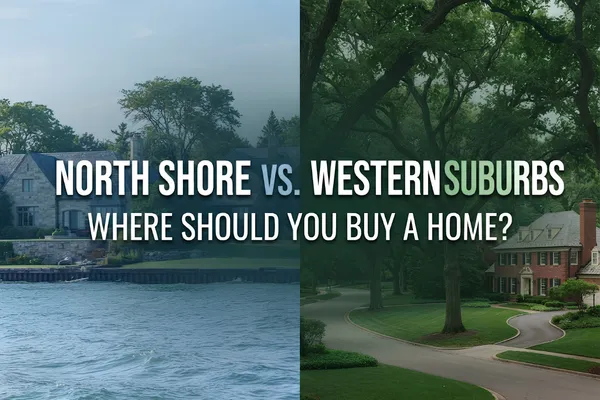
North Shore vs Western Suburbs: Home Buying Guide 2026
Real Estate, North Shore Homes, Western Suburbs Real Estate, Housing Market Comparison
North Shore vs. Western Suburbs: Where Should You Buy a Home in 2026?
Torn between the prestige of the North Shore and the value of Chicago’s Western Suburbs? This guide breaks down prices, lifestyle, and long‑term potential so you can make a confident decision when buying a home in 2026.
North Shore vs. Western Suburbs: Two Great Options, Very Different Vibes
When buyers start comparing North Shore homes with properties in the Western Suburbs real estate market, they are usually weighing two big questions: lifestyle and value. Both regions sit within the greater Chicago metro, both offer strong schools and commuter access, and both remain highly competitive in 2026. But the feel of day‑to‑day life, your price point, and your long‑term equity story can look very different depending on which side of the city you choose.
Rather than asking which area is “better,” a smarter framing is: Which market is better for me, my budget, and my goals for buying a home? To answer that, you need a clear, side‑by‑side housing market comparison.
Price Snapshot: What Your Budget Buys in 2026
Let’s start with the numbers. As of early to mid‑2026, the North Shore continues to sit at a premium price point compared with many Western Suburbs, though some western communities are catching up quickly thanks to strong appreciation.
Region Typical Median Price (2026) Recent Annual Growth North Shore (Chicago area) Around $630K–$680K median ~5–20% depending on town Western Suburbs (Chicago area) Roughly $415K–$625K in key suburbs ~5–15% depending on suburb
Redfin data shows a North Shore median around $676,000 in early 2026, up nearly 5% year‑over‑year, with some reports pointing to even stronger gains and extremely limited supply (Redfin, NSBAR). By contrast, April 2026 figures for the Western Suburbs show detached median prices of about $415,000 in Lombard, $575,000 in Downers Grove, and $625,000 in Glen Ellyn (Option Premier).
📌 Key Takeaway: If you are stretching every dollar, the Western Suburbs generally give you more house for your money. If you are prioritizing prestige and long‑term price strength, North Shore homes remain a blue‑chip choice.
Inventory & Competition: How Hard Is It to Win a Home?
In 2026, both markets favor sellers, but the degree of competition is different. On the North Shore, inventory often sits around 1–1.5 months of supply—far below the 4–6 months that signals balance. That means buyers face multiple‑offer situations on move‑in‑ready properties, particularly in towns with top‑tier schools and easy commuter rail access. Well‑priced, updated homes can sell in days, not weeks, and buyers frequently waive contingencies or stretch above list to secure them (zNorthShore).
In the Western Suburbs, inventory is still tight, but there is generally a bit more breathing room. Communities like Lombard and Villa Park show steady, predictable growth with less of the frenzied bidding war environment seen in some North Shore enclaves. As mortgage rates hover in the mid‑6% range, more move‑up sellers are listing, creating opportunities for buyers who are prepared and realistic on price (Jake Kilts).
Well‑presented homes in both regions still attract multiple offers in 2026.
Lifestyle: How Do North Shore Homes Feel vs. Western Suburbs Living?
Numbers aside, your experience of a neighborhood matters. Many buyers fall in love with the North Shore for its tree‑lined streets, historic architecture, and proximity to Lake Michigan. Think charming downtowns, beaches, trails, and a strong emphasis on quality of life. Reddit threads and local commentary frequently highlight the region’s liberal, community‑minded culture, top‑ranked schools, and a sense of generational stability—families who buy here often stay for decades.
The Western Suburbs deliver a slightly different flavor of suburban comfort. Here, buyers often prioritize space: larger backyards, multi‑car garages, and newer construction with open‑concept floor plans. Many communities—Downers Grove, Wheaton, Glen Ellyn—offer walkable downtowns, respected school districts, and Metra access into the city. For families who want a practical, family‑friendly environment with strong amenities and a bit more elbow room, Western Suburbs real estate checks a lot of boxes (Option Premier).
💡 Pro Tip: Spend a full Saturday in each area. Visit parks, coffee shops, and grocery stores, and time your commute. The “feel” of a place is hard to capture in online listings alone.
Long‑Term Potential: Equity, Stability, and Resale
From an investment standpoint, North Shore homes have a long track record of resilience. Limited land, enduring demand for lakefront and near‑lake living, and consistently strong school districts have supported price growth over multiple cycles. Recent data showing double‑digit year‑over‑year gains in some quarters underscores how quickly values can move when inventory is tight and demand is high (John Nash Homes).
In the Western Suburbs, the equity story is more nuanced but no less compelling. Suburbs like Downers Grove and Glen Ellyn have seen robust appreciation—Downers Grove’s detached median jumped more than 14% year‑over‑year in April 2026—while “value” markets such as Lombard and West Chicago are steadily climbing from a lower base. For buyers focused on long‑term upside, this can be attractive: you enter at a lower price and potentially benefit from both organic demand and spillover from more expensive areas.
Buying a Home in 2026: How to Decide Between the Two
With mortgage rates still above 6% nationally and Chicago‑area prices projected to climb roughly 5% in 2026, your decision about where to buy a home should balance emotion and strategy. Here are some practical questions to ask as you compare the North Shore vs. Western Suburbs:
What is my realistic all‑in budget? Include taxes, insurance, and likely renovation costs. If your upper limit is around the mid‑$400Ks, the Western Suburbs may offer more options without compromising too much on lifestyle.
How important is prestige or a specific school district? If you have the budget and want a “forever home” in a marquee district, stretching for the right North Shore property can make sense, especially if you plan to stay 10+ years.
Do I value space more than address? Buyers who dream of larger yards, newer construction, or a dedicated home office often find better choices in Western Suburbs real estate at a given price point.
What’s my time horizon? If you expect to move again within five years, focus on areas with strong resale demand and diverse price points, so your home appeals to a wide pool of future buyers in either region.
💡 Pro Tip: When comparing homes, track not just list price, but price per square foot, age of major systems, and likely maintenance over the next 5–10 years. A “cheaper” home can quickly become costly if it needs a roof, windows, and mechanicals.
North Shore vs. Western Suburbs: Quick Housing Market Comparison
Price Level: North Shore is generally higher, often starting in the $600Ks and climbing sharply in prime towns. Western Suburbs offer a broader $400K–$600K band with some rapidly appreciating pockets.
Competition: Both are competitive, but North Shore inventory is especially tight, making turnkey properties harder to secure without aggressive offers.
Lifestyle: North Shore leans coastal, historic, and prestige‑oriented; Western Suburbs lean spacious, family‑friendly, and value‑driven, with strong but slightly less flashy amenities.
Long‑Term Outlook: Both regions are projected to see continued price growth in 2026 and beyond, with the North Shore benefiting from scarcity and brand appeal, and the Western Suburbs benefiting from affordability and steady in‑migration.
So, Where Should You Buy a Home?
If you are seeking a definitive winner in the North Shore vs. Western Suburbs debate, the truth is that the right answer depends on you. For buyers with higher budgets who prioritize lake access, historic charm, and marquee school districts, North Shore homes remain an exceptional choice—especially if you plan to stay put and ride out multiple market cycles.
For buyers focused on maximizing space, staying within a specific monthly payment, or entering the market sooner rather than later, Western Suburbs real estate offers compelling opportunities. You can still access strong schools, charming downtowns, and reliable commuter options, often with a bit less competition and a bit more house for your money.
Whichever direction you lean, the most successful buyers in 2026 are those who treat buying a home as both a lifestyle choice and a financial strategy. Work closely with a local agent who understands micro‑trends within each suburb, get pre‑approved before you tour, and be prepared to move quickly on the right property. In a market this competitive, clarity and preparation are your biggest advantages.
Ultimately, there is no wrong answer in this housing market comparison—only the answer that best fits your budget, your priorities, and the life you want to build in the years ahead.